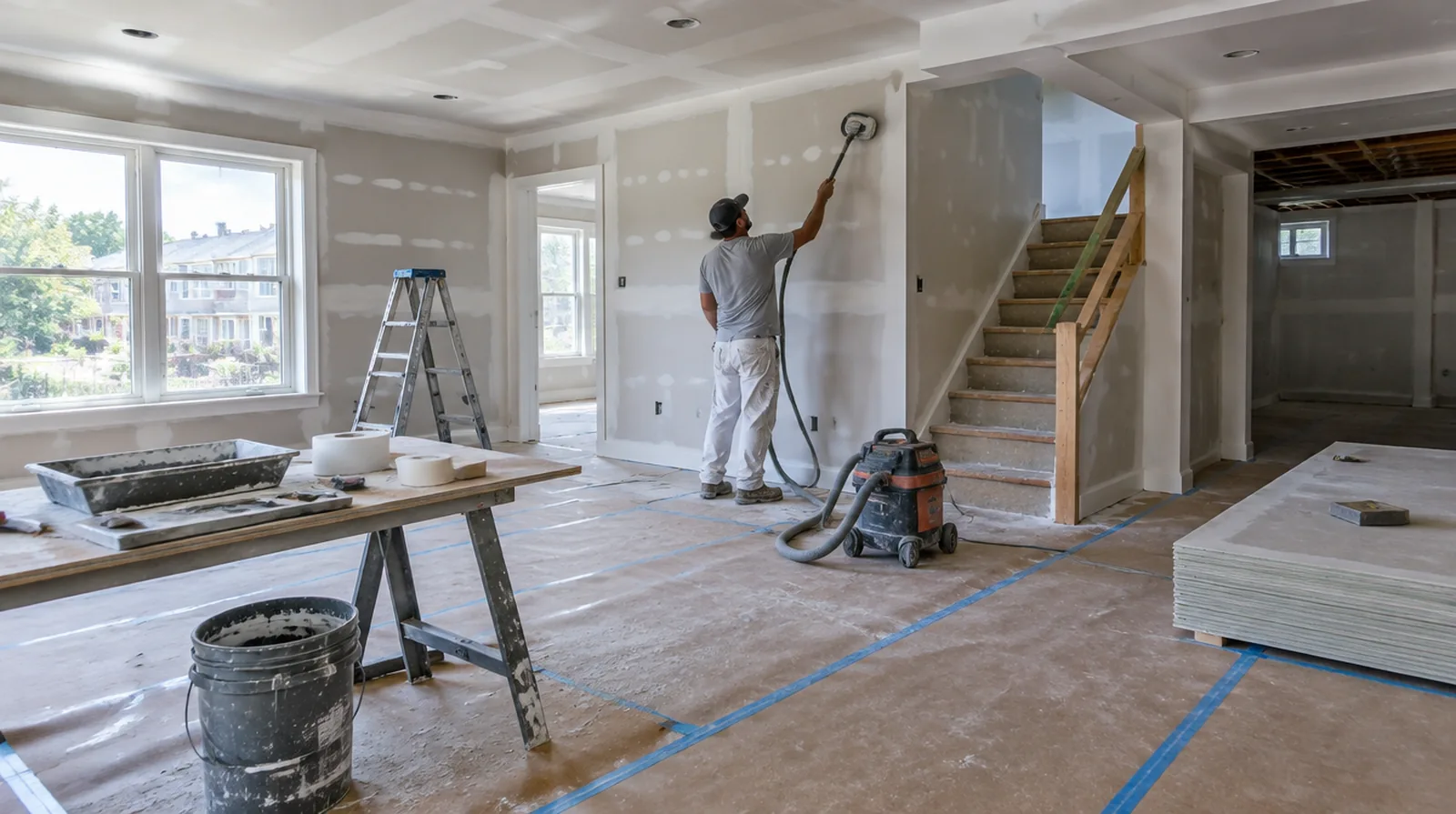
Coordinate with the painter
Primer may expose small imperfections that were challenging to see on the raw white surface. Establish responsibility for those final adjustments and any review after priming before the work starts. If the surface condition is uncertain, allow for an assessment that can distinguish stable material from layers that should never be covered.
Cover fastener heads
Fill fastener depressions level with the surrounding face without creating unneeded mounds. Adjust any projecting or paper breaking screw before applying material over the location. For a repair that crosses several surfaces, measure the affected planes separately so the estimate can explain where each finishing treatment starts and stops.
Choose joint materials
Bedding coats and final coats serve distinct purposes and may use different compatible compounds. Choose compatible compounds with regard to their intended purpose, the space and the relevant product instructions. If the wall work belongs to a broader renovation, coordinate its order with flooring, cabinetry and trim rather than scheduling finishing in isolation.
Keep external corners straight
A corner profile only produces a straight visible line when it is fitted and coated correctly. Resolve distortion or damage to the bead before successive coats make correction more difficult. If the room will remain occupied, identify a workable separation between the work area and the space that still needs daily access.
Assess the hung board
Misaligned panels or unsupported joints need attention before the finishing layers can perform properly. Check how the sheets sit and how the fixings hold them instead of beginning with compound immediately. For a surface that will receive wall covering, share the product requirements early so the finishing stage supports the planned decorative treatment.
Inspect the whole wall
Checking only the joint lines misses transitions near corners, ceiling edges and electrical boxes. Check the finished plane under the planned lighting and from a side angle where possible. If the space will remain occupied, identify a practical separation between the protected room and the space that still needs daily access.
Build the seam gradually
Successive coats widen the finished area and soften the transition from joint to board face. Butt joints typically need a broader blend because they lack the recessed edges of factory seams. If a room has only limited ventilation, discuss how the finishing materials can dry without disrupting comfort or spreading dust elsewhere.
Agree on the visual standard
Agree how the completed wall will be viewed and decorated before choosing the finishing standard. A written finish level gives the installer and painter a clearer shared target. For a distinctive existing pattern, retain a reference sample or detailed picture to make the matching discussion more specific.
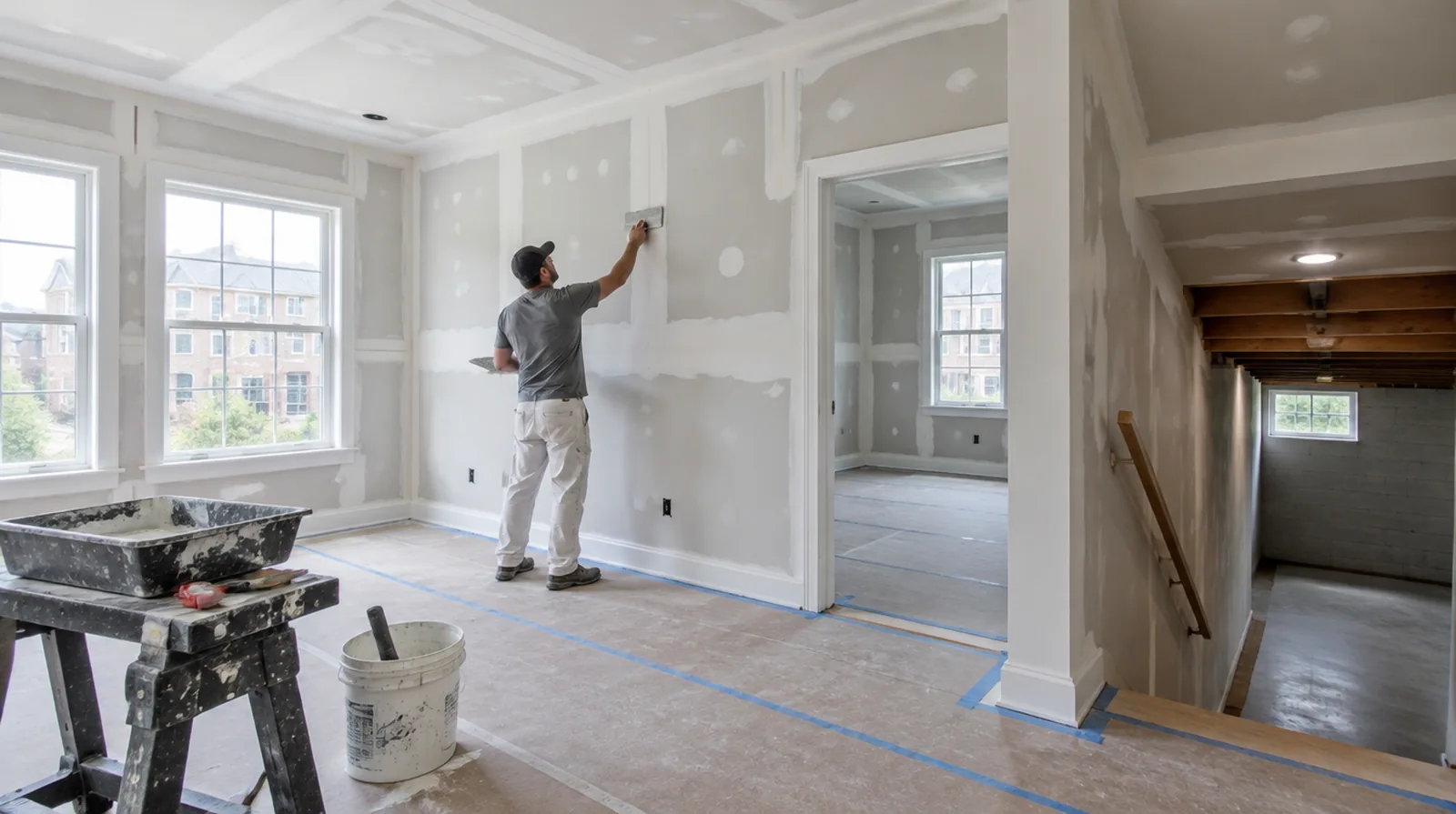
Allow genuine drying time
Do not judge a coat ready solely because its outer face appears firm. The drying interval changes with indoor humidity, temperature and the available movement of air. If materials must cross common building areas, plan the protection and access route so other occupants are not needlessly obstructed by deliveries.
Embed the tape
A continuous bedding layer supports the tape and reduces the chance of air bubbles along the seam. Inside corners need a crisp fold and balanced coverage on both faces. For a distinctive existing pattern, retain a reference sample or detailed picture to make the matching discussion more specific.
Project context in Germantown
Germantown townhomes often have finished basements where any foundation moisture should be fixed before board is replaced. Painting the full wall after a repair helps hide the edge between new compound and older layered paint.
Scope questions before finishing
If the coating stability is unclear, assess which layers are adequately bonded and which ought to be removed rather than simply hidden beneath new material.
For a planned new wall mounted fixture, resolve its backing requirements while the cavity remains open instead of cutting into completed drywall later.
For a surface carrying numerous paint layers, discuss whether differences in the retained profile or sheen justify decorating a broader area.
Where a finished perimeter is prominent, decide whether trim stays in position or is removed before agreeing how the new surface meets that edge.
If the ceiling or wall includes fittings, identify the person responsible for removing and reinstalling each item before the work begins.
Where the quoted work stops before painting, request an explicit description of what remains so the next decorating stage can be priced realistically.
When the same defect has returned, share information about previous repair methods so the next assessment can consider why they did not last.
While a removed panel exposes the wall cavity, complete the necessary review of concealed work before replacement board closes the opening.
If the completion date matters most, allow for intervals between coats as well as active labor instead of assuming the entire process happens continuously.
When building management controls access, agree delivery hours and common area protection before committing to a start or finish date.
Where a future fixture will be installed, coordinate any required backing while the cavity is accessible rather than reopening the completed wall.
When painting is outside the proposal, describe the remaining decorative preparation clearly so another contractor can price that stage accurately.
Explore the Germantown drywall overview for related options, or read the project planning information before arranging the next stage.
More planning details for Germantown
Narrow stairs between three levels of a townhome can make shorter sheets the practical choice. Leaving a small gap above the slab helps lower-level drywall in Germantown basements resist wicking. Interior units share walls on both sides, so noisy work should be scheduled considerately.